Company Insight
Sponsored by BenStop
The clever device preventing an age-old problem with uncontrolled container door movements
Standfirst...
Main image credit:
Sometimes the best innovations are born out of frustration – or in this case, an avoidable injury. After a freak gust of wind slammed a shipping container door into his shoulder, Ben Portman decided enough was enough.
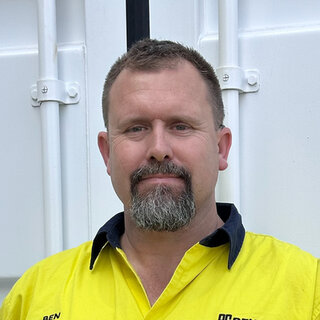
Ben Portman, BenStop Creator and Director.
The result is the BenStop GP 20/40 Shipping Container Door Brace; a deceptively simple, purpose-built device preventing uncontrolled container door movements and making worksites safer worldwide.
This is one of those inventions that seems obvious once somebody makes it, and those typically came straight out of first-hand experience and necessity. How did the BenStop Door Brace come about?
This is certainly one of those things that’s resulted from first-hand experience. Several years ago, I was working on a civil construction project, when I entered a container to grab a few tools. The doors were already open and as I was exiting the container, a gust of wind came out of nowhere and flung the door towards me. I had both hands full, so I made the split-second decision to just turn and brace for the impact. With the weight of those doors and their momentum, even with me being 6’2’’, 115kg, I was no match!
In the years since, I started looking around to see what was out there, having conversations with people and asking them about their experiences, only to find they were using things like metal bars, sandbags, pallets, spare tyres and toolboxes; just anything to hold the doors open, which creates another hazard, and nothing was engineered or rated. So, I started tinkering in the shed trying to come up with a solution – I made many prototypes! I kept trying until I found something that worked.
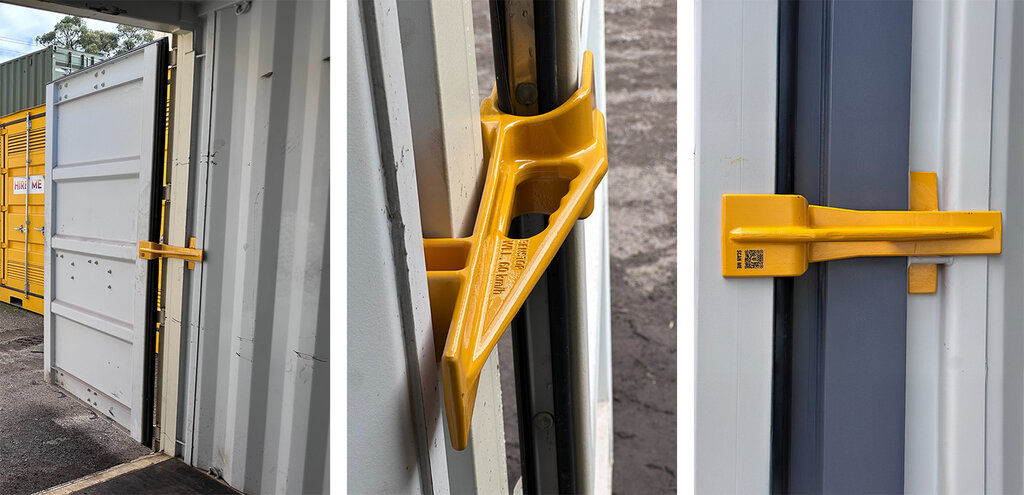
The GP 20/40 Shipping Container Door Brace, made from powder-coated aluminium, fits ISO 20- and 40-foot containers to hold a single door open at 90°, preventing movement. Its bilateral design works on both left and right doors.
It does seem like such a simple idea, but looking at it in action, you can tell a lot of thought and R&D and prototyping has gone into it. What were some of the considerations you made along the way?
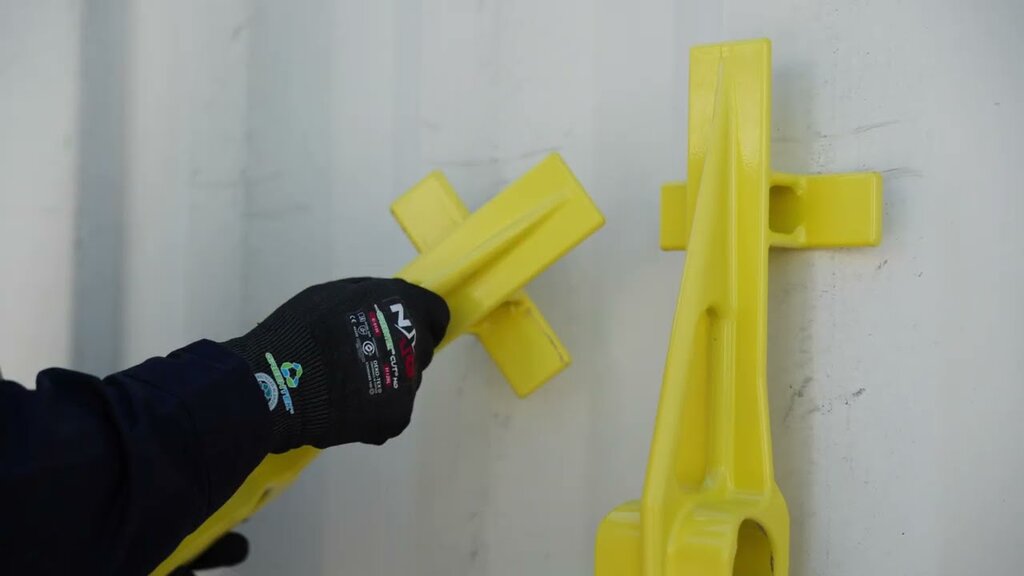
I wanted to create something that is fit for purpose, robust, universal, that could be used on both doors and rated to withstand winds and other hazards. It had to be slimline in design, easy to use, with a magnet on the back so you can pop it on and off the container wall when you have finished using it.
The most common question I am asked is: why is the brace designed to hold a door open at 90°?
Container manufacturers already provide door restraint mechanisms, but these only work when the doors can swing outward and back to approximately 270°. That is fine if you have got the clearance, but in most cases, containers are positioned side by side or close to buildings, or other structures, to maximise space. In those situations, the doors cannot fully open 270°, which makes the original restraints ineffective. Securing the doors at 90° solves that problem, the doors can be securely held open and you can still fit loading ramps for forklifts and other equipment with ease.
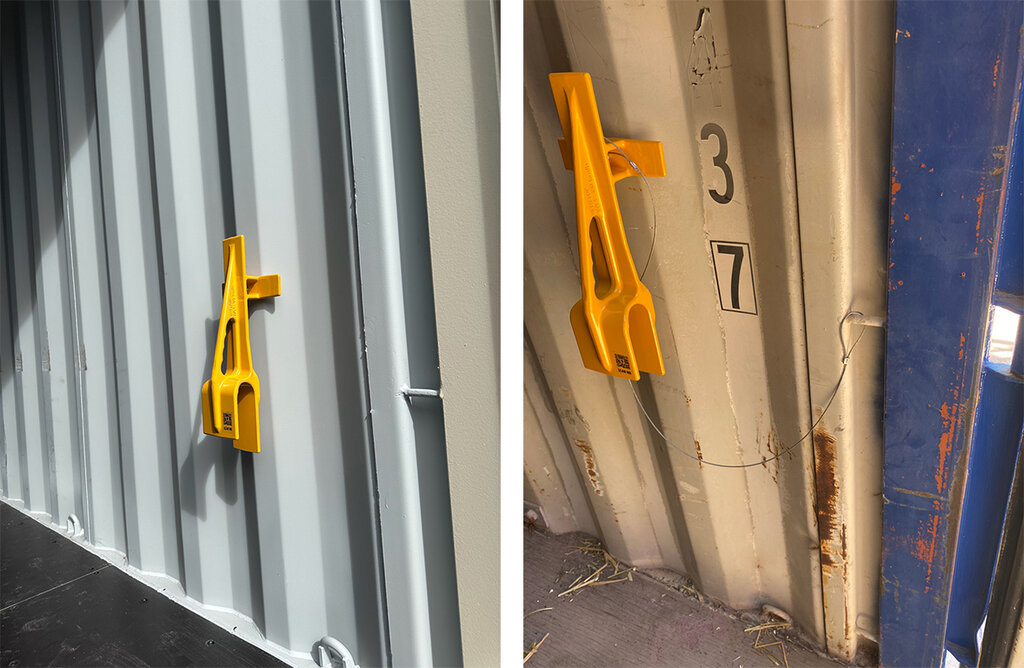
When not in use, the brace’s built-in magnet lets it attach securely to the shipping container wall for easy storage.
What has the reaction been like in the field? I can imagine it’s been a big quality-of-life improvement for many people.
It's been well received across quite a few different industries with many integrating the product into their existing workflows as a control measure.
Risk owners have reported that the device has supported them with their WHS Duty of Care obligations to provide safer entry and egress in the workplace, as many of their containers are used for workshops and storage.
We have also received feedback from firsthand users about how simple and practical the device is to use and that they are relieved that a product like ours finally exists to solve a dangerous workplace hazard.
I've met people within the mining, construction and logistics industries that have had their hand and fingers crushed, and others that have had blunt force injuries to their head, shoulder, or leg. I’ve even met people who have been trapped inside containers from whereby the door on container was blown shut and the external cam locks have grabbed, trapping them inside and two cases where someone had accidently shut the door not realising the person was still inside, Fortunately, in each of these cases, the person/s involved have managed to make contact with co-workers on the outside of the container to let them out.
Frustratingly, these types of events are not well captured in the incident data statistics and more often than not, container door related incidents and near miss events go unreported. We know that it’s a much larger issue than it may seem. At recent expos, we have met many more people, from various industries, able to recount first-hand, stories of injuries and worse, all of whom were amazed and grateful to finally see a product on the market that solves this seriously overlooked hazard.
Has it inspired you to look around at other safety blind spots and develop new products?
I've got a few other things in the pipeline, but product development is not an easy thing to do. We were fortunate enough to get the Innovation Booster Grant in 2023, which went towards financing R&D and mechanical engineering to take it to the next level.
So, while I keep tinkering on the next thing, we will be bringing the BenStop GP 20/40 Door Brace to a bunch of expos for the remainder of 2025, and we would love for people to come have a chat to us and check them out.
Caption. Credit:
You can catch Ben and the BenStop team at these upcoming events:
- Asia-Pacific's International Mining Exhibition (AIMEX): September 23-25, Adelaide Showground, Stand R07
- WA Mining Conference & Exhibition: October 8-9, Perth Convention & Exhibition Centre, Stand E130
- International Mining and Resources Conference (IMARC): October 21-23, ICC Sydney, Stand C12
Contact information
BenStop
Boddington,
Western Australia
Tel.: +61 437 243 649
Email: info@benstop.com.au
Web: www.benstop.com.au