Company Insight
Sponsored by Mipac
Mining’s data problem: why more information is making operations harder to manage, not easier
Mineral processing facilities have never had access to more operational data, yet the industry is still asking the same questions it was a decade ago. Global Growth Lead Steven Cohen and Managing Director Brian Forrester argue the answer isn’t more data it’s doing more with what’s already there.
Main image credit:
“Processing facilities are generating unprecedented volumes of operational data, which presents a decision-making challenge. We now have more sensors, historians, dashboards, and analytics tools than ever before, and operators are being asked to make increasingly complex decisions in shorter timeframes. The true opportunity now lies in turning data into operational clarity, actionable insight, and better decision-making. That is the gap we operate in, and it is a significant issue in mineral processing.” Brian Forrester, Managing Director, Mipac
MINE: The industry talks constantly about data‑driven operations. Why isn’t it working?
Steven Cohen: The honest answer is that the volume of data being generated has outpaced the industry’s ability to make sense of it.
What we see consistently is the same structural problem: four, five, six separate monitoring platforms, each with its own interface, its own data model, its own user base. OEM tools, historians, SCADA systems, laboratory systems, none of them designed to talk to each other. So, nobody has a single operational picture. The data exists, but it’s scattered.
The people who need to act on data, operators, shift supervisors, are rarely the same ones who can navigate the platforms that hold it. Even when the data is technically accessible, it doesn’t reach those who need it.
The industry has invested significantly in data capture infrastructure. The investment in the layer that makes that data usable, the integration, the context, the analytical capability, hasn’t kept pace.
MINE: Is this a technology problem or an organisational one?
Steven Cohen: Both, but the technology gets blamed more than it deserves.
The technology to solve this largely exists. What’s missing is how it’s deployed, and who owns it. OEM platforms are built to serve the OEM’s monitoring and support needs, not to integrate cleanly into a facility’s broader operational picture. That’s just the commercial reality, and in most facilities, that integration work doesn’t have a clear owner.
The other factor is time. Most processing facilities have automation and data infrastructure that’s grown organically over ten, fifteen, twenty years. Integration becomes a retrofit challenge rather than an architectural one, and that’s a much harder problem to solve.
But the question I come back to is: who in your organisation owns the operational data layer? Not the SCADA. Not the process historian. In most facilities we work with, the honest answer is nobody. And that’s an organisational problem, not a technical one.
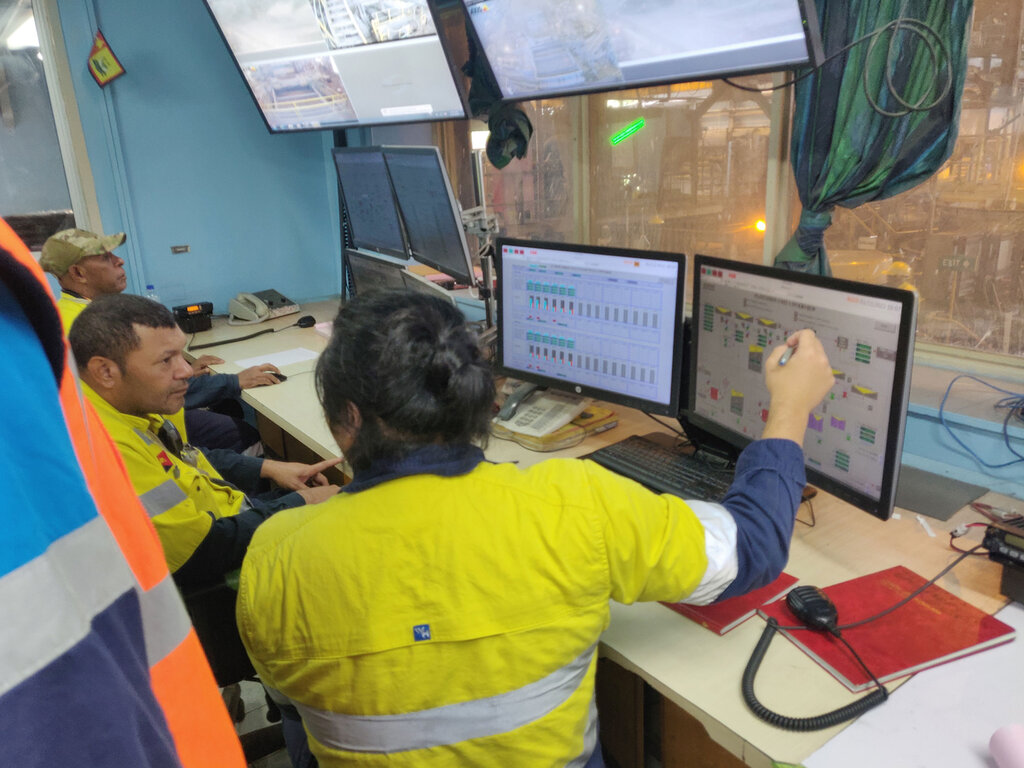
Mipac’s Hans Liang on site in PNG, training Ok Tedi team members.
MINE: What does a well‑integrated operational data environment actually look like?
Steven Cohen: It doesn’t have to mean ripping out what’s already there. The most effective approaches create a connective layer across existing systems and bring them together without replacing core infrastructure.
What you’re aiming for is a single operational view: process performance, equipment health, and quality data in one place, accessible to decision-makers, not just the analysts and engineers who can navigate the underlying platforms.
The other critical element is contextualisation. A well-integrated environment doesn’t present everything equally. It surfaces what matters, flags anomalies, and structures information around the decisions people actually need to make. What does an operator need to know at the start of a shift? What does a plant manager need for a morning review? A well-designed system answers both.
That’s the standard we’re working toward. Not a data lake. A decision-support environment built around how the operation actually runs.
MINE: Where do you see facilities wasting the most effort right now?
Steven Cohen: The most visible one is manual data reconciliation. Metallurgists and engineers pulling numbers from multiple systems, building spreadsheets, producing reports that are hours out of date by the time they’re read. That’s time spent reconstructing the past rather than managing the present.
Alarm overload is another. At some facilities, operators receive hundreds of alarms per shift. The majority are low-priority noise, but because everything looks the same, the critical signals get buried. That’s a real safety and operational risk, not just an inconvenience.
Duplicate monitoring is another issue nobody has rationalised. The same piece of equipment being watched through an OEM platform, a historian, and a SCADA screen simultaneously, with no single source of truth. People have learned to work around the fragmentation rather than fix it.
And then post-incident investigation. When something goes wrong, how long does it take to piece together what happened? If the answer is hours or days, that reveals a lot about where the integration gaps are.

Mipac is a control systems and automation specialist serving the minerals processing industry, with engineering teams across Australia and North America and project experience spanning 55 countries.
MINE: What should a processing facility be asking itself if it wants to close this gap?
Steven Cohen: First: can your operators answer the ten most important operational questions for their shift without leaving one screen? If they can’t, ask why. That’s your integration problem, made concrete.
Second: do you actually know where your data lives, and who owns each system? Most facilities have never done this, yet it’s the prerequisite for everything else.
Third: are you making decisions based on actionable information, or producing reports based on data? There’s a meaningful difference. Reports tell you what happened. Decision-support tells you what to do next. If it’s delivering the former and not the latter, examine why.
And finally: when something goes wrong, how long does it take to understand what happened and why? If that investigation process is slow and painful, it’s a reliable indicator that your data environment needs work.