Company Insight
Sponsored by Nord-Lock Group
Faster, safer, longer‑lasting: rethinking bolted connections with Nord‑Lock Group
The mining sector is notorious for being slow when it comes to embracing new technology.
Main image credit:
On a haul truck in full rotation or an excavator working deep in the pit, bolted joints rarely fail in a single moment. They loosen over time, get brought back into spec during scheduled maintenance, then return to service until the next cycle. It’s a pattern that repeats across fleets, often built directly into maintenance planning.
Suspension systems, pivot points, and structural assemblies all follow a similar rhythm. Heavy tooling is brought in, torque is set, clearances are checked, and the same joints are revisited again later in the machine’s life. Each pass carries time cost, labour demand and exposure to risk, particularly in confined or elevated working areas.
Nord-Lock Group’s bolted mining technologies sit inside that cycle, focused on extending the interval between interventions and reducing the effort required when work is needed.
Designed around mining conditions
Mining equipment operates under high load, high vibration, and limited access conditions. Bolted systems need to function reliably in those environments, not just in controlled workshop settings.
Nord-Lock Group’s mining-focused bolted designs incorporate handling features, protective finishes and alignment-friendly geometry to support field installation across mobile fleets and fixed plant.
Haul truck suspensions are one of the most maintenance-intensive bolted applications in mining. Conventional assemblies rely on high-torque tightening equipment and regular rework over the life of the machine.
Applications extend from haul trucks and excavators through to crushers, mills and conveyor systems, covering both mobile and stationary assets.
Superbolt® Strut Kits: designed for extended service life
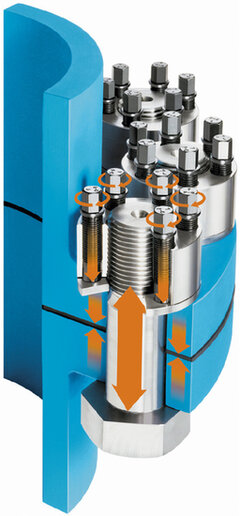
Our Superbolt® strut kits replace that approach with a multi-jackbolt tensioning system. Instead of applying load through a single large fastener, force is distributed across multiple smaller jackbolts that can be tightened using standard hand tools or a dedicated direct drive tool.
Once installed, the joint is designed to remain in place for the full service life of the suspension assembly, removing the need for mid-life replacement cycles.
Caption. Credit:
Safer installation in confined spaces
A large share of mining maintenance takes place in restricted areas beneath or around heavy equipment. In these environments, traditional hydraulic torque tools can be difficult to position and manage.
Superbolt® tensioners reduce reliance on that equipment, using smaller tools with less torque requirements, meaning the tightening process becomes more controlled at point of application.
It also means less physical strain, fewer awkward tool setups, and reduced exposure to high-energy torque systems for your technicians.
Direct drive installation: reducing time on critical joints
On large assemblies, installation time becomes just as important as reliability. A single connection can involve multiple jackbolts, and across a fleet these steps add up.
The Superbolt® direct drive tool addresses that by tightening multiple jackbolts simultaneously in a controlled sequence. Rather than working through each bolt individually, the system applies uniform load across the assembly in one operation.
Expander® System: addressing pivot wear at source
Pivot joints in excavators, loaders, and dozers experience a different failure mode. Over time, movement between pin and bore leads to wear, gradually distorting the hole into an oval shape and increasing play in the joint.
The conventional response is line boring, involving welding, machining, and re-cutting the bore. While effective, the process is temporary and must be repeated as wear returns.
Caption. Credit:
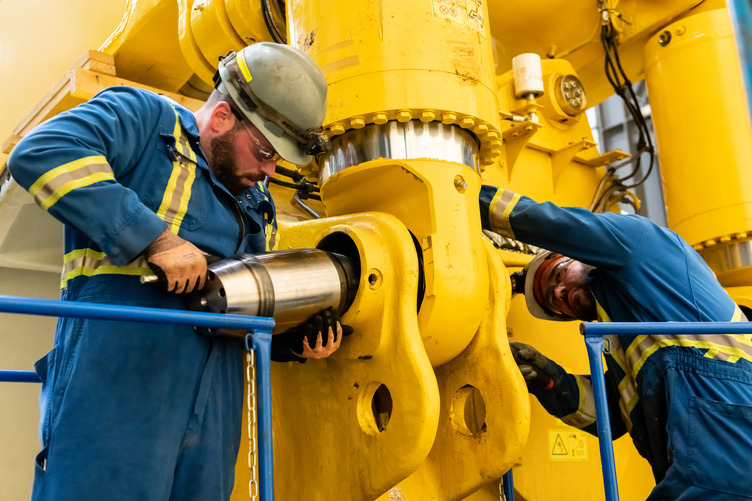
The Expander® System removes internal movement within the joint using expansion sleeves that lock the pivot pin into place. Load is distributed across the bore in a way that prevents further elongation, while accommodating existing wear at installation.
In many cases, this removes the need for repeating line boring entirely. On large equipment, even a single avoided intervention represents significant savings in both cost and downtime, and those savings scale quickly across a fleet.
Field performance and real-world application
At SMS Equipment, Expander® pins were installed on a Komatsu 980E haul truck during initial assembly. The installation used standard hand tools and reduced torque requirements, simplifying the build process while establishing a long-life pivot configuration from the outset.
At Carajás mine in Brazil, rope shovel maintenance teams faced a recurring bottleneck in sideframe work. A full set of bolted connections typically requires close to three hours using conventional methods. With Superbolt® tooling, that time was reduced to under one hour, cutting installation time by around 70 per cent and reducing physical strain during the process.
Across both examples, the outcome was consistent: faster installation, fewer manual steps, and reduced intervention time on critical joints.
Cost and lifecycle impact
The largest cost driver in bolted maintenance is repetition. Tooling, labour, downtime and hardware replacement accumulate each time a joint is accessed.
Superbolt® and Expander® solutions reduce the number of interventions required over the life of an asset. In many cases, joints remain in service without intermediate maintenance, removing entire cycles from the cost structure.
Across haul truck and large pivot applications, total cost of ownership reductions exceeding 80 percent have been observed, driven largely by reduced downtime and elimination of repeat maintenance work.
Caption. Credit:
In practice, many installations do not require ongoing adjustment once correctly installed. Clamp load remains stable over extended periods, and joints continue through the full life of surrounding components.
This changes maintenance planning. Instead of scheduling repeated bolt-related work, attention shifts toward components that genuinely require intervention, reducing the overall maintenance burden across the fleet.
Industry direction and adoption
Safety requirements in mining continue to tighten, particularly around high-energy tooling, confined-space work and manual handling risks. Reducing reliance on hydraulic torque systems directly addresses several of these focus areas.
Adoption typically begins with targeted trials on individual machines or joints. Once performance is demonstrated in service, deployment often expands across fleets and sites.
To learn more about how Nord Lock’s bolted mining technologies can benefit your fleet, get in touch with the team today.
Contact information
Nord-Lock Group
Expander
Paul Yoong
Tel.: +61 449 258 829
Email: paul.yoong@nord-lock.com
Expander
Paul Yoong
Tel.: +61 449 258 829
Email: paul.yoong@nord-lock.com
Superbolt
Steve Brown
Tel.: +61 414 586 417
Email: steve.brown@nord-lock.com
Web: www.nord-lock.com