Feature
Case study: BHP looks to mining waste for more copper
With copper demand rising and supply tightening, BHP and SiTration are testing copper recovery from mining waste. Scarlett Evans reports.

Main image credit: Vitezslav Vylicil / Shutterstock.com
Our appetite for copper is unquenchable. The metal sits at the centre of the technological transformation reshaping the global economy, from AI data centres and defence systems to electric vehicles, renewable power and the transmission and distribution infrastructure needed to connect it all. Copper’s combination of conductivity, durability and versatility makes it fundamental to the electrified, increasingly digital economy.
The International Energy Agency (IEA) describes this as the “Age of Electricity”, with copper at the heart of the expansion. Its latest critical minerals outlook identifies copper as having the “largest volume growth” among the minerals it assesses, with demand expected to increase by around 7 million tonnes (mt) by 2040. Yet expanding supply is proving considerably harder. Based on the current project pipeline, the IEA expects the copper market to face a supply deficit of around 25% by 2035.
GlobalData’s outlook similarly points to sustained demand growth. According to a June 2026 report, Global Copper Mining to 2035, global copper consumption rose from 15.2mt in 2000 to 28.9mt in 2025 and is forecast to reach 38.1mt by 2035, a compound annual growth rate (CAGR) of 2.9%. The market, it says, is “pivoting to a new demand engine, transition technologies” as electrification deepens.
There is, however, a difference between forecasting more copper production and actually bringing it to market. GlobalData expects mined copper production to rise from 22.9mt in 2025 to 34.5mt in 2035, based on currently known projects. However, the IEA points to declining ore grades, rising capital intensity, a shrinking rate of new discoveries and project lead times of around 17 years as structural constraints on supply. The agency notes that the average global copper mine grade has fallen 40% since 1991, while the capital intensity of brownfield expansions has increased by 65% since 2020.
At the same time, copper prices are making the metal harder to ignore. Prices briefly exceeded $14,500/t in January 2026, according to the IEA, having passed $12,000/t for the first time only a month earlier. The combination of strong demand, high prices and constraints on new supply is increasing the incentive to look for copper beyond conventional production, including in material that mining companies have historically treated as waste.
Copper’s supply problem
Australia is a useful case study. It held 10.2% of global copper reserves in 2026, according to GlobalData and US Geological Survey data, while producing 721,500t of mined copper in 2025. Yet Australian mines are also generating the waste streams that could contain recoverable metal. It is against this backdrop that BHP and MIT spinout SiTration are testing whether copper dissolved in mining waste liquids can be turned into a saleable product.
“Copper grade has dropped extremely rapidly in the last 35 years,” Brendan Smith, co-founder and CEO of SiTration, tells Mining Technology. “Since 1990, we have seen roughly a 50% decline in copper grade in ores being mined on average globally and that is only accelerating. There is no way around it.”

Brendan Smith, co-founder and CEO of SiTration.
The company tested its approach in a five-week project in June in South Australia, collaborating with BHP Invent and Copper South Australia. It reported a 99.9% purity in copper recovered from residual waste liquids, with the project providing a test of the technology under operating conditions.
Turning mining waste into a resource
SiTration’s technology uses a form of electrowinning called electroextraction, which uses an electric current to extract copper from a dissolved state.
“The copper ions essentially adhere to the electrode materials we are applying the voltage to,” Smith says. “We can recover that adhered copper as a sheet of material that would be identical to copper produced at any typical mine site.”
The method itself is not new, but Smith says SiTration has adapted it for the particularly harsh conditions found in mining waste streams.
“Mining waste streams are, in general, very difficult to operate in and most technology is just not compatible,” he says. “We have developed electro-materials that can withstand very harsh, acidic conditions.”
The technology can also recover copper from feed streams across a wide range of copper concentrations, which the company says could allow recovery from streams that had previously been considered uneconomic. For the electro-extraction cell, the company uses what it calls a flow-through cell, rapidly moving the mining liquid through the system.
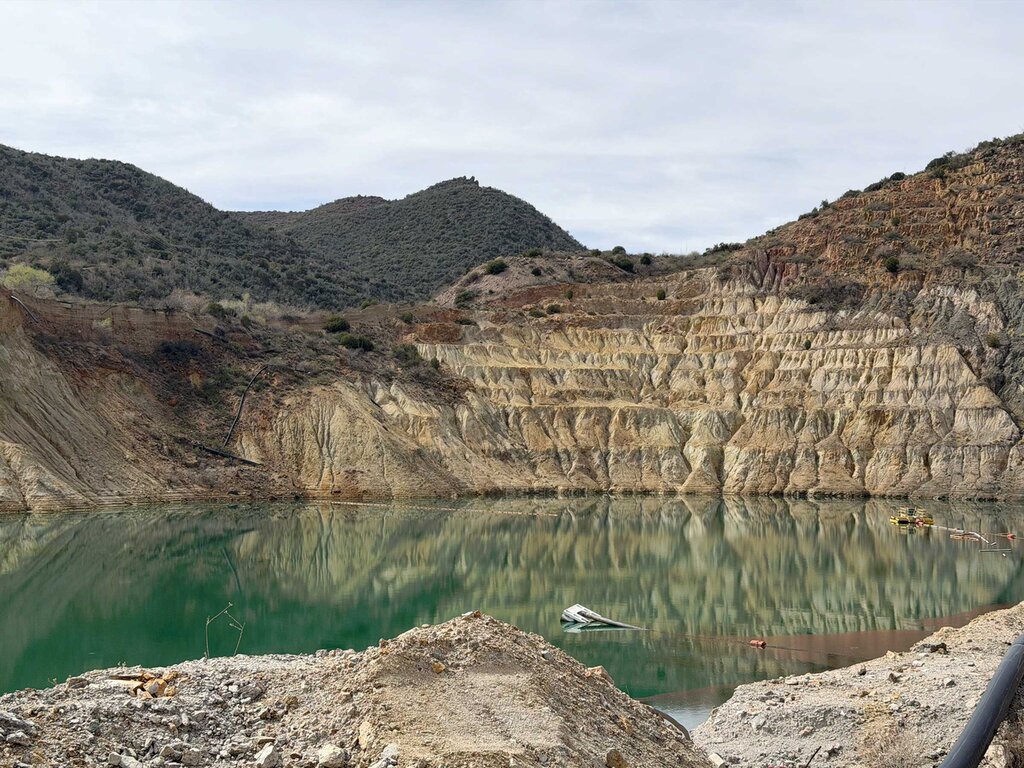
A legacy pit lake at the BHP Copper Cities site in Arizona, US. Credit: BHP
This was designed to increase extraction efficiency, allowing economic recovery of copper at concentrations below 0.5g/litre – and potentially as low as 0.2g/litre.
By comparison, Smith says conventional electrowinning typically takes place after copper has already gone through a longer concentration and purification process, with solutions containing around 50g of copper per litre. SiTration therefore targets copper solutions that are up to 100-times more dilute, allowing the technology to be applied directly to some mining water streams.
Another element that sets the technology apart is the fact that it is a solely electrical process. This means it can be adjusted in real time, with the team using sensors to monitor incoming and outgoing streams, and alter electrical parameters to optimise energy use, copper recovery and product purity.
The technological capability has been demonstrated, but Smith argues that its biggest challenge is changing an established approach to mine waste. “Currently there is no real harvesting of copper (or other minerals for that matter) from waste streams,” he says. “The mining industry has not, historically, had many viable options for processing streams such as tailings water or acid mine drainage, aside from containment.”
The company’s project with BHP in June was presented as a significant step in changing this norm.
From South Australia to Arizona
The South Australian trial was a finite demonstration rather than a permanent installation, but a telling one. Smith says the five-week operation was long enough to prove the system could remain stable and consistently produce usable minerals under real conditions.
In a joint statement from BHP and SiTration, Marley Palin, acting vice-president of BHP Innovation, said the trial reflected how the company is trying to close the gap between early stage innovation and operational use.

Marley Palin, acting vice-president of BHP Innovation.
“By accelerating innovation in processing technologies, we can maximise every tonne mined, through reducing inputs and lowering energy and water use,” he said.
For SiTration, the validation has led to further work with BHP, including an early stage trial at the time of writing at a legacy site in Arizona in the US, with a larger deployment planned for later this year.
The Arizona work was being carried out at BHP’s historic Copper Cities site in the Globe-Miami mining district. The site produced nearly 400,000t of copper between the 1950s and early 1980s, leaving a legacy of mining-impacted water from which the companies were seeking to recover additional copper.
The Arizona deployment began with a one-month small-scale pilot in August, with SiTration monitoring the system’s performance from a distance, followed by a larger two-month deployment planned for October, and is set to produce around 2t of commercial-scale copper cathodes over the course of a two-month autonomous deployment.
If successful, the product could be sold directly into the global copper supply chain without further refining, giving SiTration a further validation milestone as it seeks to scale the technology to commercial deployments.
Beyond the pilot
Beyond BHP’s own trials, the bigger question is whether the industry can follow suit at scale. If mining waste streams can be efficiently tapped as a resource, the opportunity could be significant.
“Mine waste is humanity’s largest waste type,” Anita Parbhakar-Fox, honorary professor-geosciences at the University of Queensland (UQ), tells Mining Technology. “There are about 100 billion tonnes of waste generated every year, of which copper mining accounts for around 5–10%.”

Anita Parbhakar‑Fox, honorary professor‑geosciences at the University of Queensland (UQ).
In research that Parbhakar-Fox led at UQ, significant copper concentrations were found in Australian tailings, waste rock and slag. In a survey of around 80 sites, the highest concentration observed was around 38,000 parts per million, or 3.8% copper, in mine tailings at a South Australian site.
Technologies aside from electrowinning are also being developed to unlock harder-to-recover copper. Rio Tinto’s Nuton, for example, uses bioleaching to extract copper from sulphide ore rather than dissolved metal in mining water. The company produced its first Nuton copper at Arizona’s Johnson Camp mine in late 2025, illustrating the wider industry push to develop alternative processing routes.
Alternative processing technologies nevertheless face the same commercial challenge: demonstrating reliable recovery at a cost that justifies deployment.
“In terms of technical barriers, progress is being made at developing bespoke technologies to unlock more copper from both waste and ore materials,” Parbhakar-Fox says. “The bigger challenge is, of course, developing robust business cases for adopting mine waste innovations like these.”
That is consistent with what Smith describes as the technology’s real competition: not other companies, but inertia. While most mining waste is simply left in containment, Smith says any site with copper tailings could be a viable use case for SiTration’s technology.
“Most copper mining sites are in some way, shape or form interesting to us for the deployment of our mobile systems,” he says. “Some of these sites have upwards of half a billion dollars of copper just literally sitting there in the water that has been historically inaccessible.”
Parbhakar-Fox says regional processing hubs could provide one way of making the economics work where individual mine sites lack sufficient volume to justify investment in new processing infrastructure. In regions such as Mt Isa in Queensland, where multiple operations share similar geology and mineralogy, waste from several sites could potentially be processed through a common facility.
Such hubs could also improve the economics by recovering other materials alongside copper, including cobalt, sulphur, quartz and iron oxides. “The way to really make a meaningful contribution is to push towards a zero-waste scenario,” Parbhakar-Fox says, “where whilst the copper may motivate the project as first prize, the additional minerals and metals are also techno-economically assessed.”
For now, the task for SiTration and BHP is to prove that dilute copper in mining liquids can be recovered reliably, efficiently and at commercial scale. The South Australian trial suggests the technical potential; the larger question is whether the economics will support wider adoption.
