Comment
New technologies target energy use in Australian ore processing
From alternative crushing to coarse‑particle flotation and dry separation, miners are exploring ways to reduce energy and water demand. Analysis by Eve Thomas.

Main image: Ore washing and concentrating with water and a vibrating screen. Credit: Alexey_Rezvykh / Shutterstock.com
Comminution is mining’s most energy-intensive process, estimated to account for up to 3% of the world’s total energy demand. It is water-intensive too, accounting for between 65% and 78% of the mining sector’s total water usage.
Among Australian innovators, there is a drive for efficiency improvements. New technological developments signal a responsiveness to resource cost and scarcity, while deals indicate that operators are looking for efficiency savings across circuits.
Some efficiency losses are unavoidable – energy is lost through heat and vibration during the crushing stage – but there is obvious wastage: large swathes of processed material ultimately hold little or no value but are crushed and ground before separation. Ore preparation has thus emerged as an area for improvement, as has coarse particle flotation.
Further down the processing chain, dry separation holds promise for reducing water usage, particularly in areas experiencing groundwater stress.
Most emerging technologies are pre-commercial, but operators are involved in research projects and are tracking developments closely, conscious that energy prices will remain volatile and water strains will last.
Can crushing do more of the work?
South Australian (SA) company Gyratory Roller Solutions (GRolls) combines pulsed compression, tension and shear forces to produce a finer product during the crushing stage.
Adelaide University researchers investigated efficiency, and found that the process reduces more than 40% of particles to below 425 microns (µm) in a single pass and generates less than 14% of fine particles smaller than 75µm. The results also noted that the technology performs particularly well with finer ore feeds under 2.36mm.
The process was modelled against an existing conventional grinding operation at an unnamed copper-gold operation in New South Wales. The GRolls circuit demonstrated a 20% reduction in energy consumption and almost halved total comminution costs.
“These are significant savings,” said GRolls director and Adelaide University PhD candidate Mark Drechsler. “Not only do you reduce power use, but you eliminate the cost of grinding minerals. There are also potential savings in water usage and a reduction in greenhouse gas emissions.”
The technology is still pre-commercial, but the results demonstrate an appetite for diversifying crushing and grinding processes.
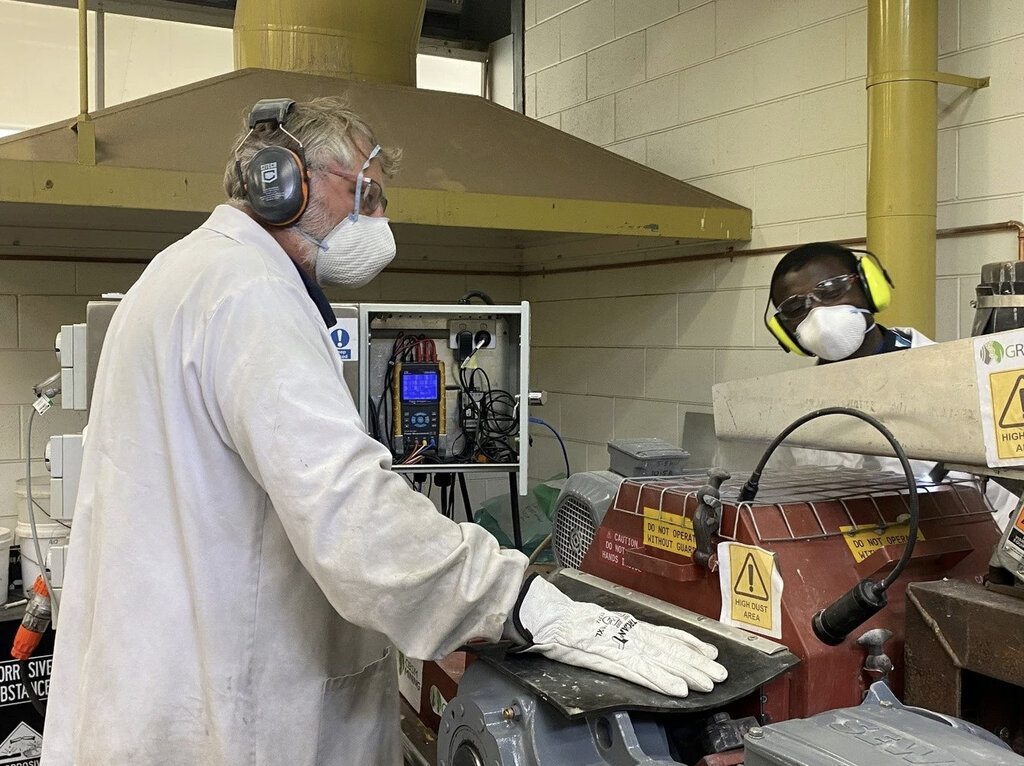
GRolls researchers test the company’s crushing technology, which uses pulsed compression, tension and shear to produce a finer product during the crushing stage.
Recovering minerals without such fine grinding
Elsewhere, researchers are exploring efficiency improvements in separation, looking to reduce energy usage by minimising grinding.
Separation is typically achieved using conventional flotation, which works most effectively on relatively fine particles of between ten and 200µm. Ore must therefore be extensively ground – an energy-and water-intensive process – before minerals can be separated from waste.
The University of Queensland’s Collaborative Consortium for Coarse Particle Processing Research programme has worked to reduce the need for grinding by using coarse particle flotation techniques, which can recover valuable minerals at sizes between 150 and 600µm or, in some cases, up to 1mm.
The programme’s first phase was completed in 2025; it included the development of the JKHFmini, a bench scale fluidised bed flotation device that can help predict the performance of full-scale coarse particle mineral processing.
“We have developed this specific technology [the JKHFmini], but now we can use it to generate more knowledge about any part of the flotation process,” said Liza Forbes, CPR programme director and associate professor at the Julius Kruttschnitt Mineral Research Centre.
The second phase has commenced and will run until 2030, and includes BHP Group Operations, Capstone Copper Corporation, Codelco, Eriez Flotation Division, Hudbay Minerals, Newmont, Northparkes Mining Services, Rio Tinto Technological Resources and Vale Technology Development.
Although still pre-competitive at this stage, the consortium’s work is intended to reduce mine waste and energy usage.
Reducing water use as well as energy
The wider push to reduce resource use also applies to water-intensive processes, with innovators pushing to develop dry processing.
In August 2026, SA company DryFlow Magnetics completed its first commercial-scale waterless processing unit, which was exported to a mine in the western US – a region notable for its groundwater stress.
DryFlow’s magnetic separation process is designed to remove waste rock from low-grade magnetite before further processing, producing a higher-grade iron concentrate and cutting water usage by 95% compared to conventional wet beneficiation.
A dry ore feed is fed directly onto the belt and run through a stacked magnetic separation zone, which acts on iron-bearing particles. Using this method, the company says it can upgrade ore containing less than 30% iron to more than 67% iron, with the resulting concentrate suitable for direct reduced iron production.
DryFlow Magnetics is also developing a modular system, which it expects to be capable of processing 200 tonnes an hour, with planned units in SA under a commercial agreement with Peak Iron Mines.
Conventional will last, but there is a shift
While new technologies hold potential, conventional comminution circuits will remain a fixture of the upstream mining industry. However, recent deals demonstrate that operators are looking at traditional crushing and grinding infrastructure more holistically, with recent deals favouring fully integrated circuits.
In July, Weir signed a contract with Brightstar Resources covering a 1.5-million-tonnes-per-annum (mtpa) crushing circuit at the Laverton gold project in Western Australia, using jaw and cone crushers. The deal fits the broader global shift towards circuit-wide integration. According to Jyotirmoy Roy, general manager for the Asia-Pacific region for equipment solutions at Weir, “miners are taking a more holistic view of their operations; rather than looking at pieces of equipment in isolation”.
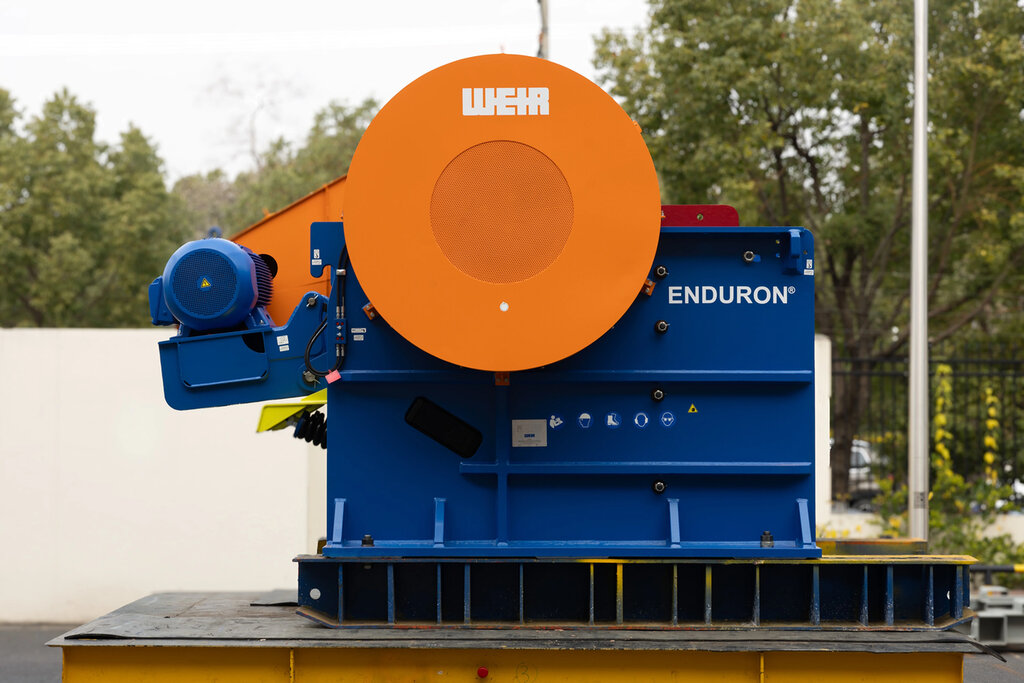
Weir’s ENDURON ET jaw crusher, which will form part of the crushing circuit for Brightstar Resources’ Laverton gold project in Western Australia.
At the Mt Bundy gold project in the Northern Territory, the story is similar. In August, Delonix Solutions announced that it would provide the full design, engineering, procurement, construction, installation and commissioning of the dry plant. The plant will use a series of crushers including high-pressure grinding rolls to reduce ore for processing.
The plant is designed to handle up to 7mtpa of ore, compared with a planned operating rate of 5.5mtpa, providing capacity for future expansion. Completion and commissioning are targeted for December 2027, with first gold expected in the first quarter of 2028.
Looking ahead
Increasingly, Australian miners are pushing for efficiency in comminution. Deals are trending towards holistic circuits, while emerging technologies are rejecting waste earlier and crushing more efficiently.
As energy prices rise and water scarcity becomes an increasing concern, there is a clear drive to reduce water and energy usage, and Australian innovators are pushing to lead in the technological solutions available.
